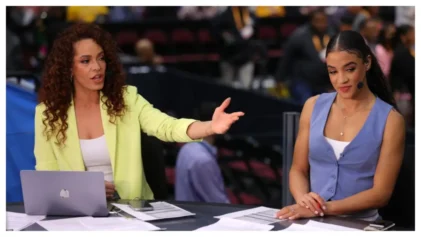
There are likely not many people out there who have a better pulse on WNBA discourse than TV host and personality Elle Duncan.
Duncan, a former ESPN “SportsCenter” anchor who now covers the WNBA for the USA Network and other sports events for Netflix, recently explained her thoughts on the fact that political and culture wars have seemed to swallow up the conversation surrounding the league.
For an “exhausted” Duncan, the WNBA has turned into the most toxic space to cover in sports.
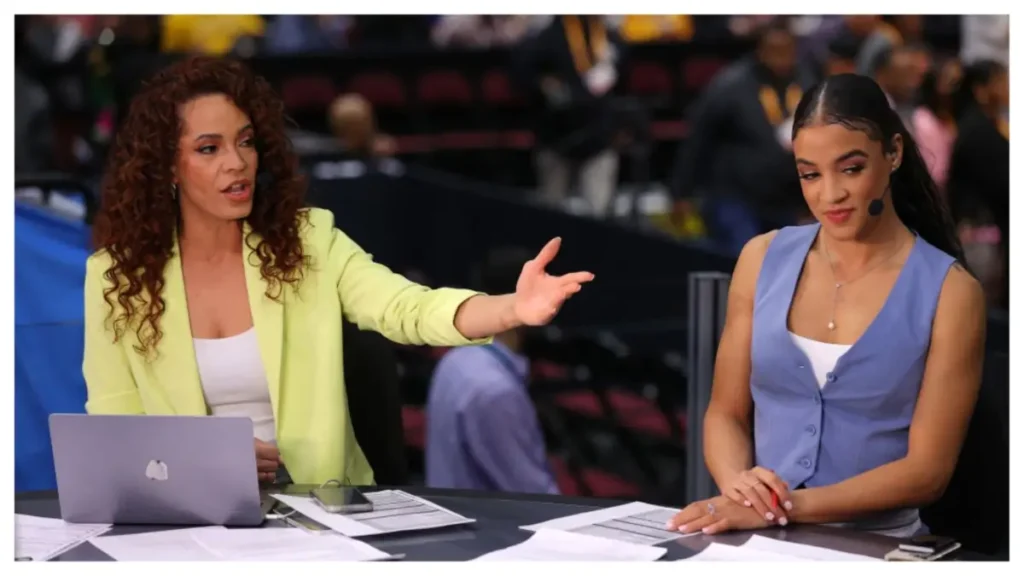
“Exhausted, tired, trepidatious. It’s a cacophony of feelings,” Duncan told “Sports In America” podcast host David Greene about her current view of the narratives clouding the WNBA.
“Because I think I remember how much passion, energy and excitement there was for the attention that these women were finally getting,” Duncan continued, “and the ratings and this new crop of superstars that were going to come into the league and help elevate this game even more.”
“And it would finally be all of these women sowing everything or reaping everything that they had sowed through all these years,” she continued. “And very quickly over the course of the last three years, it’s just turned into, as you said, a sticking point for sides to continue to politicize things that shouldn’t be, to be as divisive as possible.”
“To put it frankly, David, and this is not just me speaking, this is me as a person who covers a lot of sports and has a lot of friends that cover a lot of sports … right now, the WNBA is the most toxic space to cover, and that’s incredibly frustrating and sad,” the veteran sportscaster concluded.
Of course, the increased attention surrounding the WNBA coincided with the drafting of Indiana Fever star Caitlin Clark in 2024. The fact that Clark is white, while the majority of the WNBA is composed of Black women, opened the floodgates for bad actors to craft divisive narratives around race whenever Clark had tense moments on the court with opponents.
Since Clark’s immense popularity was driving the growth of the WNBA, it also caused many Black players, in some instances, to feel like they needed to stand up to protect the history and reputation of players that built the WNBA before Clark arrived; this further alienated some supporters of the Fever star.
The controversy perhaps reached a fever pitch this season, when Republican lawmakers wrote a letter to WNBA commissioner Cathy Engelbert threatening legal action if the league did not did not address what they deemed as targeted physical play against Clark.
Phoenix Mercury forward Alyssa Thomas served a one-game suspension in June after striking Clark in the throat while they were on ground fighting for a loose ball; Thomas later told reporters she received death threats about the kerfuffle.
Then, in July, Clark’s Fever teammate Sophie Cunningham provided a gateway for more political debate due to an interview released by ESPN. In the interview, Cunningham spoke out against allowing trans women to compete in women’s sports.
Her comments led to multiple protests outside WNBA games, including during a Fever game against the Seattle Storm in July. The Storm were fined and co-owner Celeste Keaton was suspended from attending five games after she confronted two young fans that held signs in support of Cunningham on the front row during the game.
More racial debate was sparked recently after Chicago Sky guard DiJonai Carrington referenced “white privilege” following her ejection for a flagrant foul on Cunningham.
For all the perceived distractions surrounding the WNBA, though, people still seem interested in watching.
Sunday’s game between Clark’s Fever and Angel Reese’s Atlanta Dream had the most viewers ever for a WNBA game on cable television.
“There is so much that we should and could be talking about,” Duncan said. “And instead every other day, it’s an examination of what this foul means and a generalization of what this league is about and an admonishment of the women before.
“And it just feels like we are in a perpetual cycle that we can’t break out of,” Duncan lamented.